4. The Qubit: Superposition
The Qubit: Superposition
You have accepted the rules. Now, let’s define the key resource: the **Qubit**.
The Qubit: Superposition
A **Qubit** (Quantum bit) is the physical realization of a two-level quantum system. While a classical bit stores a value of 0 or 1, a qubit exists in a **superposition** of the two basis states, $|0\rangle$ and $|1\rangle$.
The Hard Truth: Superposition is the result of Postulate 1 (State Space). It simply means the state of the qubit is a **unit vector** that is a linear combination of the basis vectors $|0\rangle$ and $|1\rangle$:
$$|\psi\rangle = \alpha|0\rangle + \beta|1\rangle$$where $\alpha$ and $\beta$ are the complex **probability amplitudes** you mastered earlier.
⚠️ The Misconception
You must avoid the naive interpretation that a qubit is "simultaneously 0 and 1." This analogy is fundamentally misleading.
- A qubit is **one single state** ($|\psi\rangle$) that exists in the Hilbert space. It is a single vector, not two separate bits.
- The "mixture" only reflects the **potential** outcomes upon measurement.
Until the moment you apply the measurement operator (Postulate 3), the state $|\psi\rangle$ is **pure** and single. It is the ability to manipulate the relationship between $\alpha$ and $\beta$ (especially their **relative phase**) that enables quantum computation.
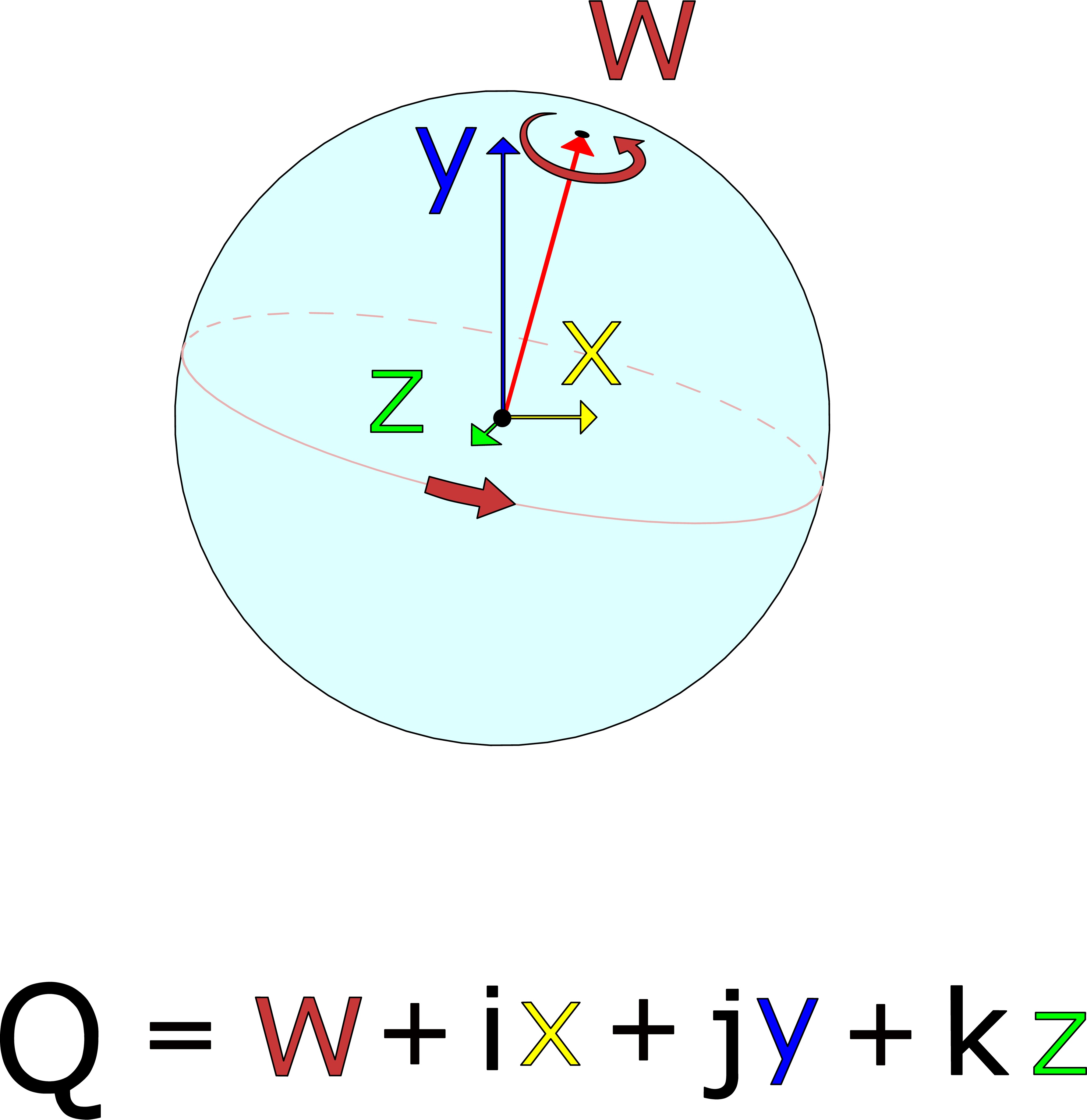
Every point on the surface of the sphere (except the poles) is a valid superposition state.
Your Task: Constructing Bias
You must be able to translate desired measurement probabilities directly into a valid state vector.
Construct a superposition state $|\psi\rangle = \alpha|0\rangle + \beta|1\rangle$ that meets the following criteria:
- The probability of measuring **$|0\rangle$** is $P_0 = 1/3$.
- The probability of measuring **$|1\rangle$** is $P_1 = 2/3$.
- Assume the coefficients $\alpha$ and $\beta$ are **real numbers** (ignore complex phase for simplicity here).
What are the specific numerical values for $\alpha$ and $\beta$ that define this state?